

3.3 Marketing Mix: Cambridge IGCSE Business 0264 lesson
3.3 Marketing Mix is one of the 4 lessons in Unit 3 Marketing of Cambridge IGCSE Business 0264, for first examination in 2027. It is an editable PowerPoint of 40 slides written against syllabus sections 3.3.1, 3.3.2, 3.3.3, 3.3.4 and 3.3.5, with 2 embedded video case studies, 0 learning checks and an exit ticket. Also suitable for Cambridge IGCSE (9-1) Business 0774 and Cambridge O Level Business 7081, which share the same content.
The longest Unit 3 lesson, covering all four Ps plus ecommerce. Product is taught through Emirates Airlines and brand image, with a video; the product life cycle and extension strategies end in a question on a cola brand whose sales have started to fall. The five pricing methods include dynamic pricing, new in 0264, with a video on Uber surge pricing. Place, promotion, ecommerce and social media marketing follow, with a question on promoting a new family restaurant.
Learning objectives
Taken from the objectives slide of the lesson, which follows the syllabus wording.
3.3.1 Product
- Advantages and disadvantages of developing new products
- The importance of brand image
- The role of packaging
- The main stages of the product life cycle: introduction, growth, maturity, decline; interpret a product life cycle diagram
- Extension strategies: new markets, new uses, adapting the product or packaging, increased advertising/sales promotion; advantages and disadvantages of each; recommend and justify an extension strategy
3.3.2 Price
- Pricing methods and their advantages and disadvantages: cost-plus, competitive, penetration, skimming, dynamic
- Recommend and justify an appropriate pricing method for a given situation
3.3.3 Place
- Advantages and disadvantages of different distribution channels: direct to customers, through retailers, wholesalers, agents
- Recommend and justify an appropriate distribution channel for a given situation
3.3.4 Promotion
- Reasons for promotion
- Methods of sales promotion, e.g. vouchers, reward schemes, competitions, special offers/discounts; methods of advertising, e.g. social media, direct/targeted emails, leaflets, billboards
- Recommend and justify which method of sales promotion and which method of advertising to use in a given situation
3.3.5 Ecommerce
- Examples of ecommerce, e.g. mobile phone/internet banking, online shopping, online ticketing
- Advantages and disadvantages of ecommerce for businesses
- Advantages and disadvantages of ecommerce for customers
What is in the lesson
The running order below is the deck as sold. Every lesson in the course follows the same shape: learning objectives, content slides with the real business examples, a learning check after each section, a case study with questions, key takeaways and an exit ticket. A teacher answer key (PDF), with model answers to every learning check, case question and exit ticket, is included when you buy the unit or the complete course.
Slide by slide (40 slides)
- Title slide
- Learning Objectives
- Learning Objectives
- Learning Objectives
- Product: Developing New Products
- Product: Brand Image
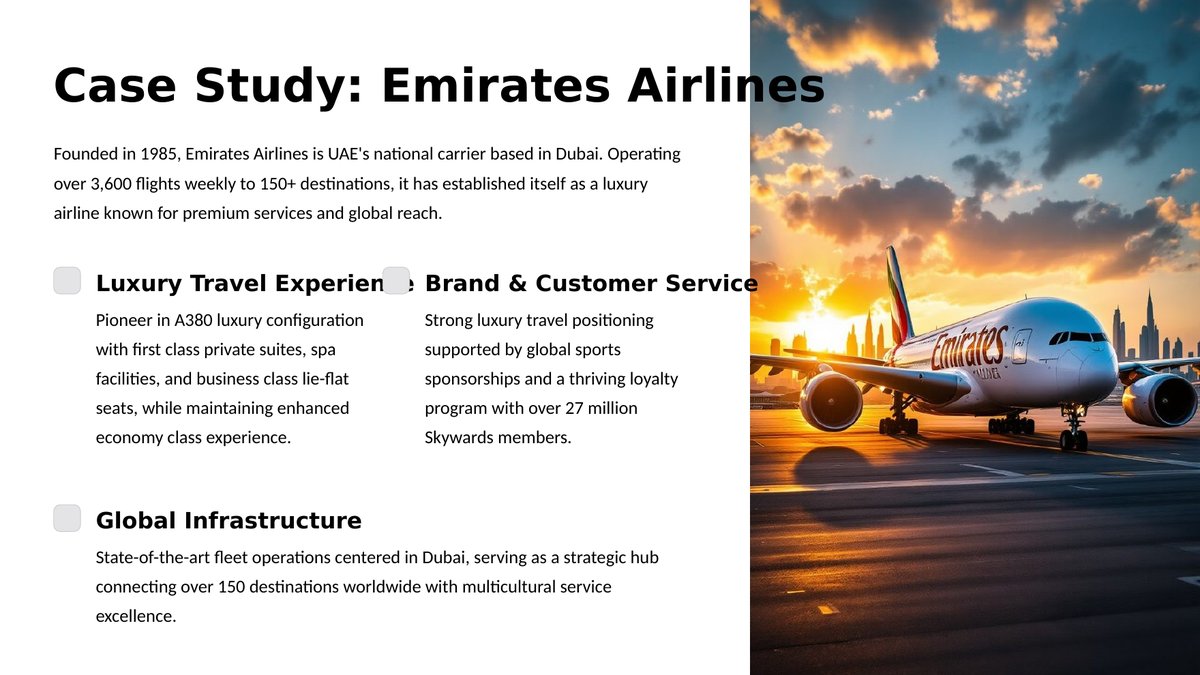
- Case Study: Emirates Airlines
- Question: Emirates has cabin crew from 150+ countries speaking 9-18 languages, and… (video)
- Product: The Role of Packaging
- Product: The Product Life Cycle
- Product: Extension Strategies
- Evaluating Extension Strategies
- Question: A soft drinks business sees sales of its main cola brand falling as the…
- Price: Cost-Plus Pricing
- Price: Competitive Pricing
- Price: Penetration Pricing
- Price: Skimming
- Price: Dynamic Pricing
- Choosing the Right Pricing Method
- Question: Uber increases its prices when lots of people want a ride at the same time,… (video)
- Place: Distribution Channels
- Direct to Consumer Distribution
- Using Wholesalers in Distribution
- Retail Distribution
- Using Agents in Distribution
- Choosing the Right Distribution Channel
- Promotion: Reasons for Promotion
- Methods of Advertising
- Methods of Sales Promotion
- Question: A new family restaurant is opening in a busy city area with a small…
- E-commerce
- E-commerce: Advantages for Businesses
- E-commerce: Disadvantages for Businesses
- E-commerce: Advantages for Customers
- E-commerce: Disadvantages for Customers
- Social Media Marketing: Overview
- Social Media Marketing: Benefits
- Social Media Marketing: Challenges
- Conclusion: The Dynamic Nature of Marketing
- Exit Ticket
Where it fits
Weeks 17 and 18 of the 0264 scheme of work and pacing guide, which gives the course 46 weeks with a mock in week 41. Previous lesson: 3.2 Market Research. Next lesson: 3.4 Marketing Strategy and Legal Controls. All 28 lessons: Cambridge IGCSE Business 0264.
How to buy
The lesson on its own: 3.3 Marketing Mix on TES. The unit: Unit 3 Marketing. The whole course in one download: 0264 Complete Bundle. Lesson 1.1 is free with its answer key if you want to see the format first.