

Quantitative skills for Cambridge Business 9609
The calculations in the Cambridge International AS and A Level Business 9609 syllabus (2026 to 2028 examinations), taught in nine PowerPoint lessons with a separate Word answer key for each one. Break-even and contribution, ratios and investment appraisal, elasticity and moving averages, decision trees and critical path analysis: the maths is set out formula by formula, with worked examples and practice questions your students can work through.
Calculation practice is the part of the course most departments never get round to building. This set is that work, done.
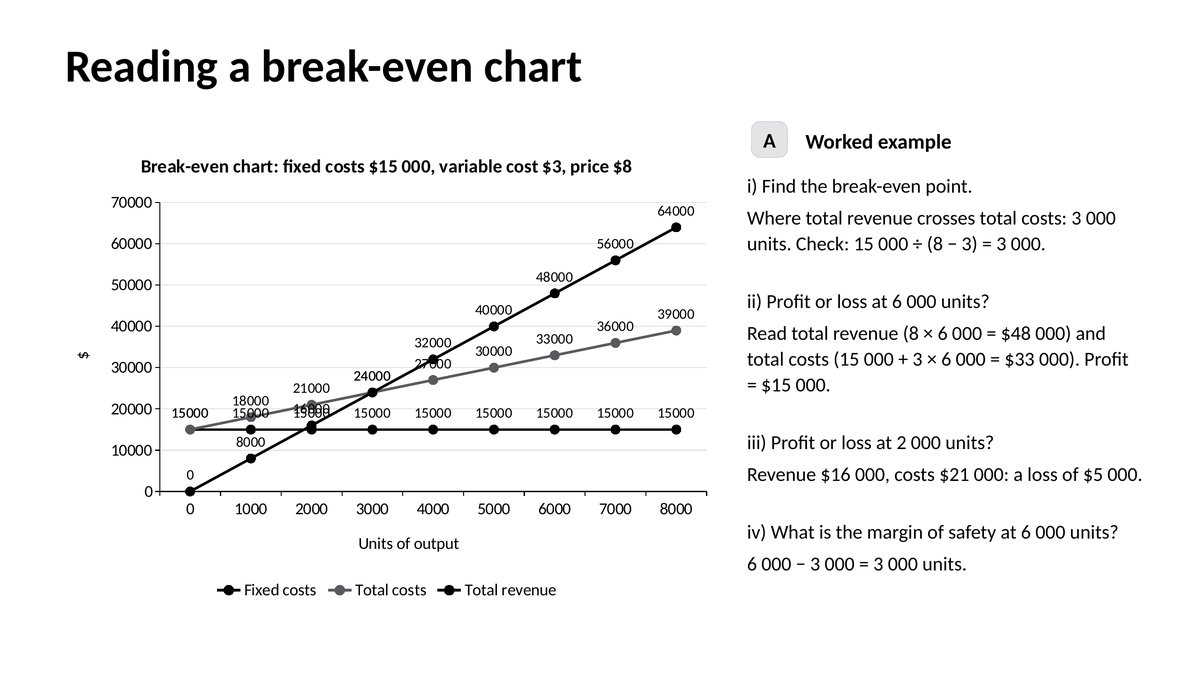
Lesson 2.2, contribution and break-even, is free with its answer key so you can see the format before you buy: download the free break-even lesson.
The nine lessons
264 slides in total, sold as one set. Every lesson is an editable PowerPoint, so you can reorder it, cut it or rebrand it for your department.
| Lesson | Title | What it covers | Slides |
|---|---|---|---|
| 1 | Key mathematical skills | Averages, fractions, ratios, percentages, percentage change, reading charts, index numbers | 42 |
| 2.1 | Costs, revenue and profit | Fixed and variable costs, unit cost, gross and operating profit, profit for the year, profit margins | 31 |
| 2.2 | Contribution and break-even (free) | Contribution, break-even output, margin of safety, break-even charts | 22 |
| 2.3 | Budgets, variances and cash flow | Favourable and adverse variances, cash flow forecasts, improving cash flow | 25 |
| 2.4 | Exchange rates and financial ratios | Currency conversion, current and acid test ratios, ROCE, gearing, efficiency ratios | 29 |
| 2.5 | Investment appraisal | Payback, average rate of return, net present value | 24 |
| 3 | Marketing | Market size, growth and share, price and income elasticity, moving averages, extrapolation, correlation | 39 |
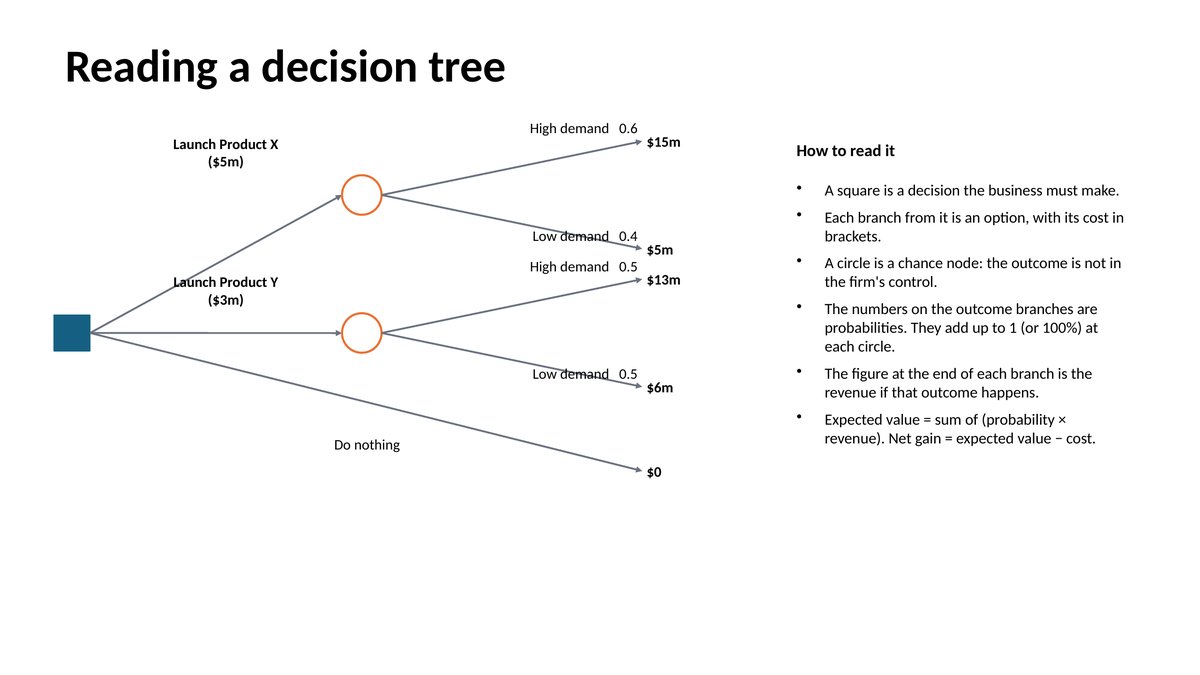
| 4 | Operations | Capacity utilisation, decision trees and expected values, critical path analysis | 28 |
| 5 | Human resources | Labour productivity, labour cost per unit, labour turnover, retention, absenteeism | 24 |
All nine lessons and answer keys: Quantitative Skills set on TES.

What is in every lesson
The nine lessons follow the same running order, so students know where they are: learning objectives, a starter, a formula slide for each concept, worked examples with the method written out next to them, guided questions that scaffold the steps, practice questions, a learning check after each section, a case study, and an exit ticket.
Answers and teaching points sit in the speaker notes, and each lesson also comes with its answer key as a separate Word document, so you can print it or hand it out. Questions are original, with worked solutions throughout, and the business contexts use US dollars.
Where it fits in your course
The set follows the 9609 syllabus order, so it slots into the schemes of work rather than replacing them. Lessons 1 to 2.5 and 5 cover AS content, and 2.4, 2.5, 3 and 4 carry the A Level calculations. Use them as standalone lessons in the finance topics, as revision before the papers, or as the calculation practice between topics.
Course pages: Cambridge AS Level Business 9609 and Cambridge A Level Business 9609. Week by week planning: the AS scheme of work and the A Level scheme of work each show the week every lesson fits, with its learning objectives against the syllabus reference.
Teaching IGCSE? The syllabus does not ask for this much, but lessons 1, 2.1 and 2.2 work as stretch material for a strong 0264 set.
How to buy
The nine lessons and the nine answer keys are sold together as one download on TES. A school licence, which covers every teacher in your department, is available at checkout. Quantitative Skills on TES.
All listings: A Level Tips shop on TES.