

2.4 Motivating Employees: Cambridge IGCSE Business 0264 lesson
2.4 Motivating Employees is one of the 4 lessons in Unit 2 People in Business of Cambridge IGCSE Business 0264, for first examination in 2027. It is an editable PowerPoint of 24 slides written against syllabus sections 2.4.1 and 2.4.2, with 2 embedded video case studies, 2 learning checks and an exit ticket. Also suitable for Cambridge IGCSE (9-1) Business 0774 and Cambridge O Level Business 7081, which share the same content.
Why people work, the benefits of a motivated workforce with the labour productivity formula, then Maslow, Taylor and Herzberg. Financial and non-financial methods each get two slides, followed by an activity on choosing a method for a given situation. Two video case studies close the lesson: DreamWorks, on non-financial motivation and culture, and Zara, which students explain through Herzberg's two-factor theory.
Learning objectives
Taken from the objectives slide of the lesson, which follows the syllabus wording.
2.4.1 The importance of a well-motivated workforce
- why people work
- the benefits of a well-motivated workforce: improved labour productivity, reduced absenteeism, lower labour turnover and greater willingness to accept change/new methods of working
- main motivational theories: Maslow, Taylor, Herzberg
2.4.2 Methods of motivation
- financial methods of motivation, e.g. time-based, piece-rate, salary, bonus, commission, profit sharing, fringe benefits
- non-financial methods of motivation, e.g. job enrichment, job rotation, training, opportunities for promotion, praise, employee of the month
- recommend and justify an appropriate method of motivation for a given situation
What is in the lesson
The running order below is the deck as sold. Every lesson in the course follows the same shape: learning objectives, content slides with the real business examples, a learning check after each section, a case study with questions, key takeaways and an exit ticket. A teacher answer key (PDF), with model answers to every learning check, case question and exit ticket, is included when you buy the unit or the complete course.
Slide by slide (24 slides)
- Title slide
- Learning Objectives
- Learning Objectives
- Why Motivate Employees?
- Why Do People Work?
- Benefits of a Well-Motivated Workforce
- Formula: Labour Productivity
- Maslow's Hierarchy of Needs
- Motivational Theories: Taylor
- Motivational Theories: Herzberg
- Learning Check
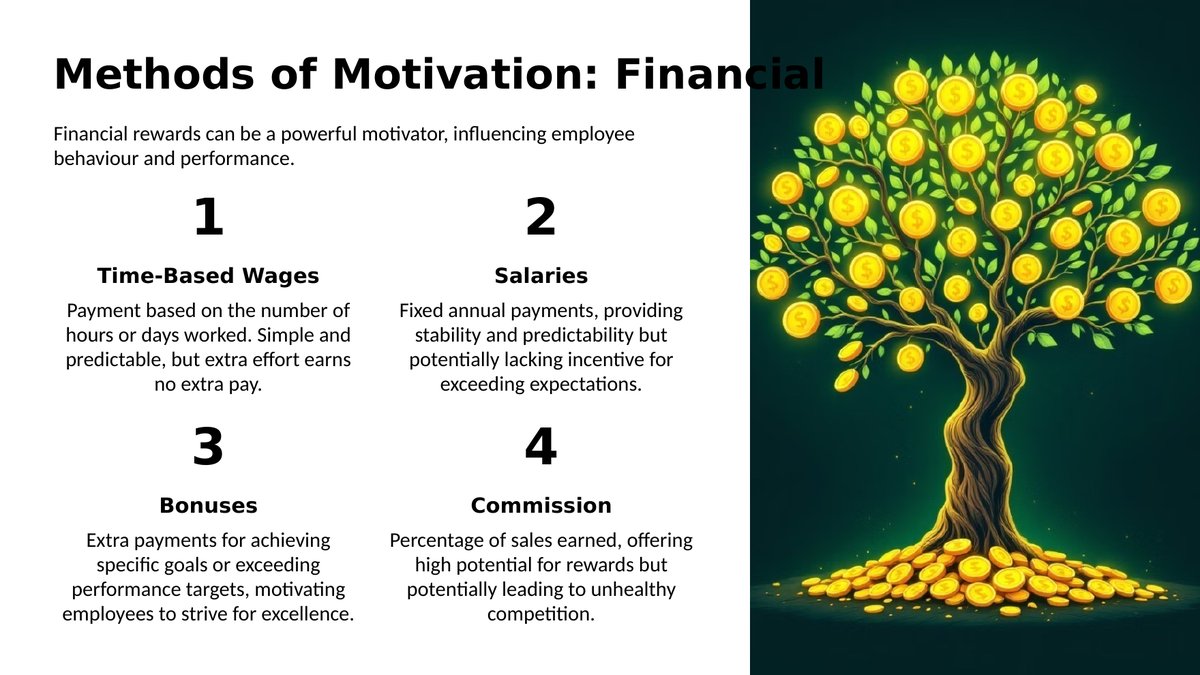
- Methods of Motivation: Financial
- Methods of Motivation: Financial (Continued)
- Methods of Motivation: Non-Financial
- Non-Financial Methods: Promotion, Praise and Employee of the Month
- Learning Check
- Choosing a Method of Motivation
- Activity: Which Method of Motivation?
- Case Study: DreamWorks Pictures
- Question: The video shows DreamWorks created a fun culture with parties, fail Fridays,… (video)
- Case Study: Zara
- Question: How does this situation relate to Herzberg's Two-Factor Theory? (video)
- Conclusion: Key Takeaways
- Exit Ticket
Where it fits
Week 13 of the 0264 scheme of work and pacing guide, which gives the course 46 weeks with a mock in week 41. Previous lesson: 2.3 Methods of Communication. Next lesson: 3.1 Marketing and the Market. All 28 lessons: Cambridge IGCSE Business 0264.
How to buy
The lesson on its own: 2.4 Motivating Employees on TES. The unit: Unit 2 People in Business. The whole course in one download: 0264 Complete Bundle. Lesson 1.1 is free with its answer key if you want to see the format first.