

6.2 Business and the International Economy: Cambridge IGCSE Business 0264 lesson
6.2 Business and the International Economy is one of the 4 lessons in Unit 6 External Influences on Business Activity of Cambridge IGCSE Business 0264, for first examination in 2027. It is an editable PowerPoint of 29 slides written against syllabus sections 6.2.1, 6.2.2, 6.2.3 and 6.2.4, with 2 embedded video case studies, 2 learning checks and an exit ticket. Also suitable for Cambridge IGCSE (9-1) Business 0774 and Cambridge O Level Business 7081, which share the same content.
The lesson opens with the Suez Canal blockage as a video case on how one ship disrupted world trade, then globalisation, tariffs and quotas, and multinationals. Vietnam is the host-country case, with a video on why a global fast food business locates there, and Shinsegae's department store in Busan is the example for external costs and benefits. Exchange rates cover appreciation and depreciation and the effect on importers and exporters, without calculations, as the syllabus notes.
Learning objectives
Taken from the objectives slide of the lesson, which follows the syllabus wording.
6.2.1 The importance of globalisation
- reasons for globalisation: improved transport links, technological change including communication, free trade agreements, newly industrialised countries
- opportunities and threats of globalisation for businesses
- import tariffs and import quotas
- effects of import tariffs and import quotas on businesses
6.2.2 Multinational companies (MNCs)
- advantages to a business of becoming an MNC
- advantages for the country where an MNC is located, e.g. jobs, exports, increased choice, investment
- disadvantages for the country where an MNC is located, e.g. increased competition, environmental damage, exploitation of natural resources, repatriation of profits
6.2.3 External costs and benefits
- external costs and external benefits of business decisions
6.2.4 Exchange rates
- appreciation and depreciation of an exchange rate
- how changes in exchange rates can affect businesses which import and export products and services, e.g. price, costs, competitiveness
Note: candidates will not be assessed on exchange rate calculations.
What is in the lesson
The running order below is the deck as sold. Every lesson in the course follows the same shape: learning objectives, content slides with the real business examples, a learning check after each section, a case study with questions, key takeaways and an exit ticket. A teacher answer key (PDF), with model answers to every learning check, case question and exit ticket, is included when you buy the unit or the complete course.
Slide by slide (29 slides)
- Title slide
- Learning Objectives
- Learning Objectives
- Learning Objectives
- The Suez Canal Blockage
- Case Study How did one ship running aground disrupt trade around the world? (video)
- What is Globalisation?
- Reasons for Globalisation
- Opportunities of Globalisation
- Threats of Globalisation
- Learning Check
- Import Tariffs and Quotas
- Effects of Tariffs and Quotas on Businesses
- What is a Multinational?
- Advantages of Becoming an MNC
- Advantages for the Host Country
- Disadvantages for the Host Country
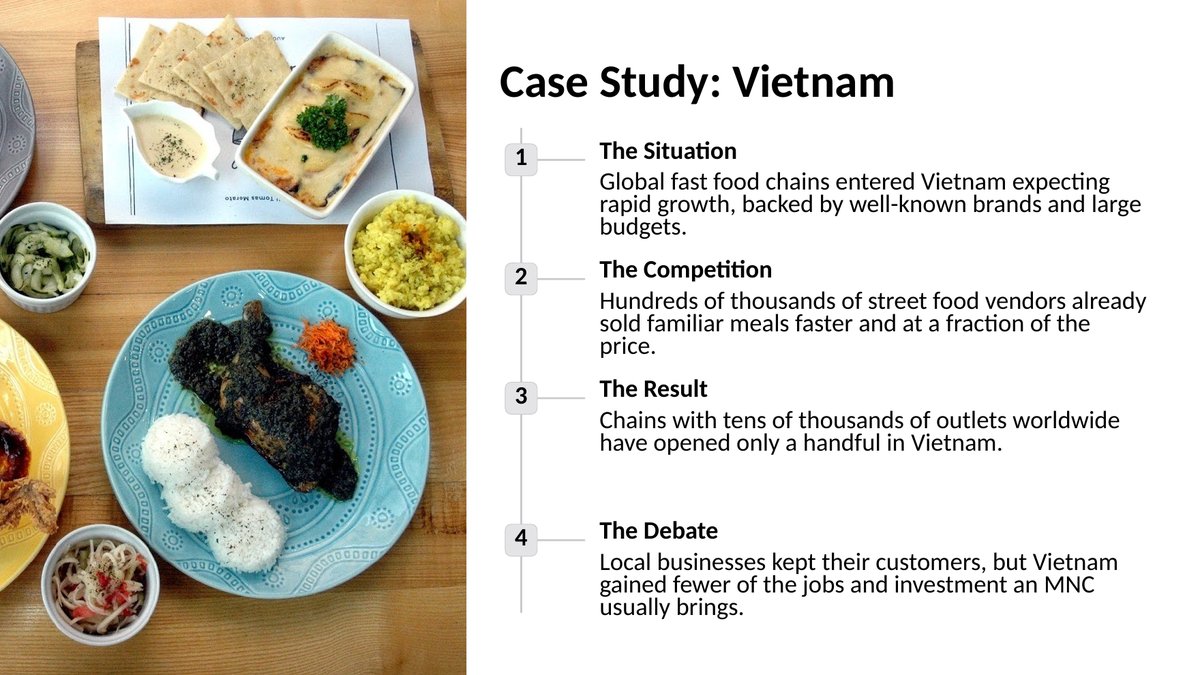
- Case Study: Vietnam
- Case Study Give two reasons a global fast food business has struggled to succeed in… (video)
- Learning Check
- External Costs and Benefits
- Case Study: Shinsegae
- What is an Exchange Rate?
- Appreciation and Depreciation
- Exchange Rates and Importers
- Exchange Rates and Exporters
- Application Task
- Key Takeaways
- Exit Ticket
Where it fits
Week 37 of the 0264 scheme of work and pacing guide, which gives the course 46 weeks with a mock in week 41. Previous lesson: 6.1 Economic Issues. Next lesson: 6.3 and 6.4 Environmental and Ethical Issues. All 28 lessons: Cambridge IGCSE Business 0264.
How to buy
The lesson on its own: 6.2 Business and the International Economy on TES. The unit: Unit 6 External Influences on Business Activity. The whole course in one download: 0264 Complete Bundle. Lesson 1.1 is free with its answer key if you want to see the format first.